



Introduction
Have you ever encountered wind-induced vibrations in a cryogenic vaporizer? This phenomenon, known as vortex shedding, can pose a significant challenge in the design and maintenance of vaporizers, especially in high-wind regions. Recently, we were involved in repairing a vaporizer that exhibited excessive vibrations at wind speeds above 30 km/h. Using Finite Element Analysis (FEA) and relevant wind load standards, we identified the root cause and developed an optimized solution to prevent future occurrences.
Understanding the Problem
The client reported unexpected vibrations in the extrusions of their vaporizer under moderate wind conditions. Upon investigation, we determined that these vibrations were caused by vortex shedding, a well-documented aerodynamic instability where alternating vortices are shed from a structure, leading to oscillatory forces. According to EN 1991-1-4 Annex E, vortex shedding can be mitigated by ensuring that the structure’s natural frequency is sufficiently high relative to the expected wind speeds.
Determining the Critical Wind Speed
To analyze the problem, we performed a series of calculations based on EN 1991-1-4. The critical wind speed—the speed at which vortex shedding begins to excite the natural frequency of the structure—was found to be 30 km/h for the existing extrusion configuration.
However, wind speeds in the project location can reach much higher values. The 10-minute average wind speed for the area, as per SANS 10160:3 (2011 Edition), is 28 m/s (100 km/h). To prevent vortex shedding, EN 1991-1-4 recommends designing for a speed at least 25% higher than the 10-minute average, leading to a target speed of 125 km/h. This means that the natural frequency of the extrusions needed to be increased to at least 35 Hz to avoid resonance at these wind speeds.
Finite Element Analysis (FEA) and Design Modifications
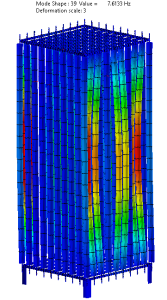
We conducted an FEA to determine the natural frequencies and mode shapes of the existing vaporizer structure. The initial analysis showed that simply adding central supports increased the frequency only to 29 Hz, which was still below the required 35 Hz threshold.
To effectively mitigate vortex shedding, we recommended adding supports at 2-meter intervals along each extrusion. The updated design achieved a much higher natural frequency of 63 Hz, effectively pushing the critical wind speed above 200 km/h.
Additionally, a FEA was performed to examine the interaction between multiple extrusions when linked together. The results indicated that while the overall unit had a lower frequency than individual extrusions, the entire system acted as a single rigid body. By treating the system as a 6m-wide structural unit, the required excitation wind speed was calculated to be above 230 km/h, well beyond realistic wind speeds in the region.
Thermal Expansion Considerations
One critical aspect of the solution was thermal expansion. Cryogenic vaporizers experience significant temperature fluctuations, and any new structural modifications needed to accommodate thermal movement. The proposed support brackets were designed to allow for relative movement between extrusions while still providing the necessary structural stiffening.
Implementation and Mass Impact
The final solution involved adding only 50 kg of aluminum supports to the existing frame—a negligible increase in mass compared to the existing structure. This ensured that the solution was both lightweight and effective, minimizing the impact on the vaporizer’s performance and structural integrity.
Conclusion
This project highlights the importance of integrating engineering analysis with practical design modifications. By leveraging Finite Element Analysis and wind load calculations, we successfully increased the natural frequency of the extrusions, mitigating the risk of wind-induced vibrations. Our solution ensures that vortex shedding will no longer be a concern unless wind speeds exceed 160 km/h, far beyond the expected operating conditions.
This case study underscores the necessity of early detection and computational analysis in structural engineering. If you’ve encountered similar challenges in your projects, we’d love to hear about them—let’s discuss solutions that work!