


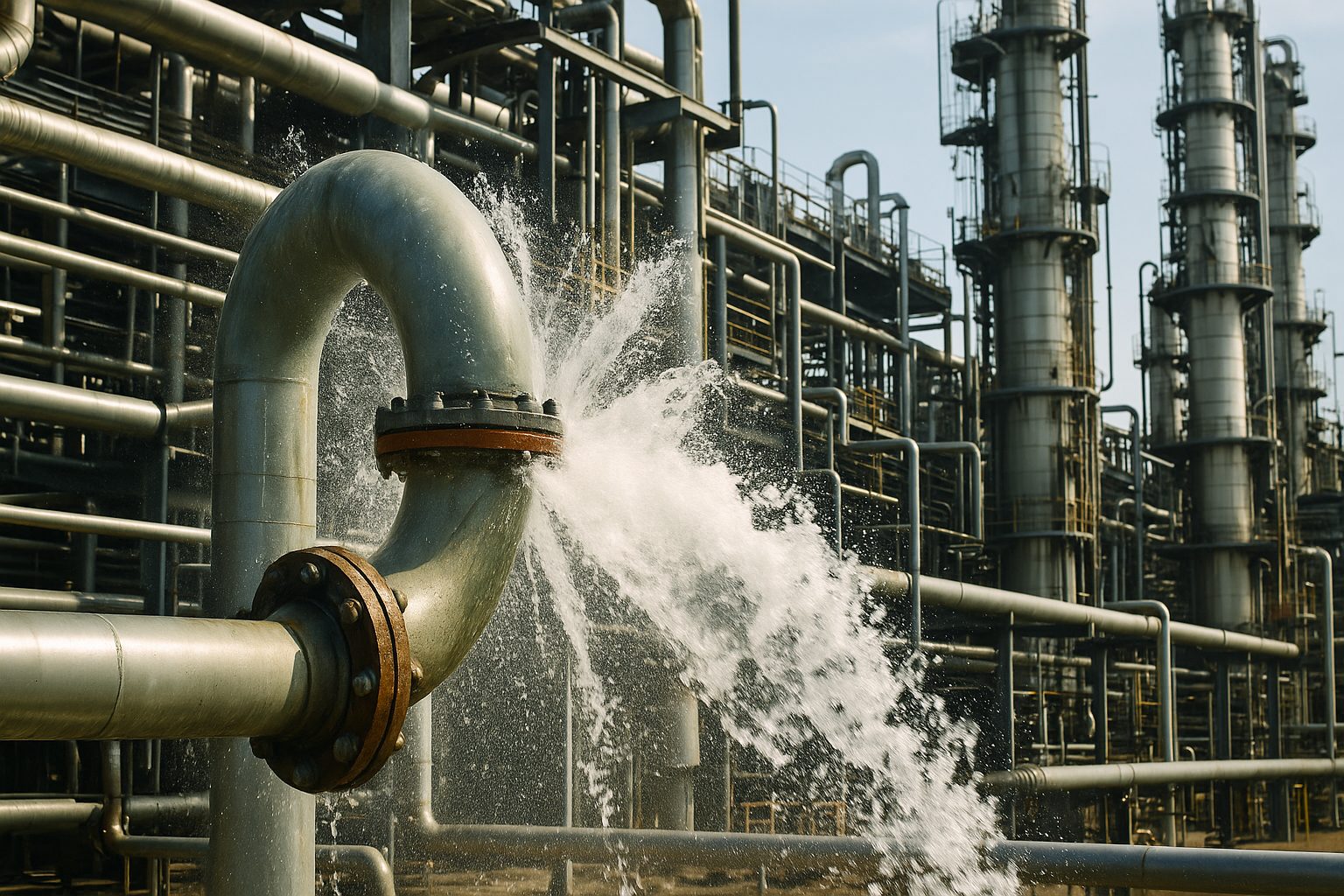
Water hammer, also known as hydraulic shock or surge, is a transient phenomenon in which a sudden change in fluid flow causes a rapid increase of internal pressure, or a pressure surge within a pipeline. This issue is of critical concern in many industries – including oil & gas, chemical processing, mining, and industrial water systems – because the resulting pressure waves can jeopardize the integrity and safety of piping networks.
In this article, we delve into what water hammer is, why it’s dangerous, and how engineers can analyse, prevent, and mitigate its effects.
1. What is Water Hammer
Water hammer is a pressure surge that occurs when a moving liquid is suddenly forced to stop or change direction, such as when a valve closes rapidly or a pump trips. This abrupt change converts the fluid’s momentum into a high-pressure wave that travels through the pipe at acoustic velocity—typically around 1000–1300 m/s in steel pipelines.
Because liquids are nearly incompressible, even small velocity changes can cause significant pressure spikes. The Joukowsky equation (ΔP = ρ·a·ΔV) describes this relationship, where ΔP is the pressure rise, ρ is the fluid density, a is the wave speed, and ΔV is the velocity change.
When a valve slams shut, the upstream fluid compresses against it, generating a pressure wave that moves upstream. Simultaneously, the downstream pressure may drop below vapor pressure, causing column separation or vapor cavities. These pressure waves reflect off elbows, tees, or closed ends, resulting in oscillating transients that dissipate over time through friction and system damping.
Common causes include rapid valve movements, pump starts/stops, power failures, check valve slam, and sudden flow demand changes. In slurry or multiphase systems, the presence of solids and air pockets can intensify the effect. In essence, any rapid flow change in a liquid-filled pipe can trigger water hammer, with faster changes creating larger surges.
Example of Water Hammer in a Process Pipe
2. Dangers and Impacts of Water Hammer
Water hammer can have devastating effects on piping infrastructure, equipment, and safety. The sudden pressure rise can be extremely high – often many times the normal operating pressure. In some cases the peak surge reached more than 300% of the pipe’s design pressure. Such over-pressurization can lead to immediate mechanical failures: bursting of pipes, ruptured gaskets, cracked flanges, and even exploded valve bodies. The shock wave’s force can dislodge pipe supports or cause pipe whip.
The operational and economic consequences of water hammer are significant. Components struck by the pressure wave may be damaged or destroyed – for example, fragile instruments can shatter and pumps or turbines subjected to reverse-flow surges may experience shaft or impeller damage. A pressure spike can force open spring-loaded reliefs or burst rupture discs unexpectedly. At the very least, water hammer often manifests as loud banging noises and vibration, which indicate stress and can loosen supports over time. In worse cases, it results in fluid leakage or pipe rupture, releasing hazardous or scalding fluids.
Fatigue and long-term damage are another concern. Even if a single surge doesn’t break the system, repeated pressure oscillations can weaken pipes and supports. The transient oscillation imposes cyclical stresses that might crack welds or threaded connections over time.
3. Prevention Methods (Design Strategies and Operational Practices)
Given the hazards, preventing water hammer is a critical design consideration. The fundamental principle is simple: avoid sudden changes in flow velocity. In practice, engineers employ a combination of design features and operational controls to “soften” transient events so that pressure surges are kept within safe limits. Key prevention strategies include:
- Valve Selection and Sizing: Fast-acting valves often cause water hammer. Use slow-closing or damped valves where possible. For example, actuated globe or ball valves can be tuned to close gradually, unlike swing check valves that may slam shut. Replace problematic swing checks with spring-assisted “silent” check valves, which close smoothly before flow reversal. A paper mill eliminated severe hammer issues by doing so. Valves with adjustable actuation (e.g., butterfly valves with controlled actuators) are preferred to reduce sudden flow changes.
- Controlled Pump Operation: Gradual pump startup and shutdown reduce shock loads. Use VFDs or soft-start/stop systems to avoid sudden flow changes. For large pumps, flywheels or slow-closing discharge check valves help absorb surges during power loss. Avoid emergency stops where possible—surge anticipator valves or bypass lines can relieve pressure spikes. When operating multiple pumps, stagger start/stop sequences to minimize transients.
- Surge Relief Devices: Physical relief paths help control pressure spikes. Relief valves open briefly when pressure exceeds a set limit (e.g., 10% above normal), discharging fluid to a tank or atmosphere. Rupture disks offer rapid protection but require replacement after use. Bypass lines with orifices can also be used around fast-closing valves to maintain limited flow and dissipate energy, preventing abrupt stops.
- Air/Vacuum Valves: Column separation and collapse can cause severe water hammer. Air/vacuum valves at high points and pump discharges release air during filling and admit air during down-surges to prevent vacuum formation. This cushions the returning water column and avoids violent collisions. Proper sizing and placement are critical—reclosing too quickly can cause secondary pressure spikes, so orifices are often used to vent air slowly.
- Vacuum Valves: Severe water hammer can result from column separation and sudden rejoining. Vacuum breaker valves, placed at high points and pump discharges, vent air during filling and admit air during down-surges to prevent vacuum formation. This cushions returning water and avoids pressure spikes. Proper sizing and placement are key—reclosing must be controlled, often using orifices, to prevent secondary surges.
- Pipeline Design and Layout: Thoughtful layout can reduce water hammer risk. Avoid dead-ends and long, unbranched runs where pressure can build. High elevation differences (e.g., pumping 300 m uphill) increase surge potential, so consider adding surge tanks at high points. Pipe material also affects surge severity—flexible materials like HDPE or PVC absorb more energy due to their elasticity, reducing wave speed and pressure spikes. Selecting pipe schedules and materials with surge resistance in mind is key to safe design.
- Operational Procedures: Many water hammer events stem from poor operating practices. Train personnel to open and close valves slowly—taking 30 seconds instead of 5 can significantly reduce surges. Where manual control is unreliable, use actuators with preset stroke times. Sequence also matters: gradually reduce flow (e.g., via recirculation) before full shutoff. In one offshore system, closing the upstream valve first helped ease pressure decay. Alarm and interlock systems should include surge suppression—such as pump trip delays or surge anticipator valves—to prevent abrupt shutdowns.
In summary, the most effective way to prevent water hammer is to design systems with transient behaviour in mind from the outset. As a common engineering principle states: slower pressure changes result in lower surge pressures. By combining well-timed flow control with appropriate surge mitigation devices, engineers can typically keep pressure spikes within safe limits.
4. Surge Analysis: Transient Modelling Tools and Key Parameters
Surge, or water hammer, is a complex transient phenomenon that occurs when flow changes rapidly in a pressurized piping system. Due to the difficulty of solving these transients analytically, engineers rely on specialized software to simulate pressure wave propagation, assess risks, and design appropriate protections.
Tools like AFT Impulse, Hydrosystem and Bentley OpenFlows HAMMER are widely used to model surge events. They incorporate methods such as the Method of Characteristics to simulate how pressure waves evolve in time, factoring in pipe lengths, diameters, wave speeds, valve/pump behaviors, and fluid properties. These tools also provide libraries of standard components and surge protection devices for realistic modeling.
The process begins by building a steady-state hydraulic model, including all relevant system elements: pipes, fittings, pumps, valves, tanks, and reservoirs. One critical input is wave speed (celerity), which depends on the fluid’s bulk modulus and the pipe’s elasticity. For instance, steel pipes yield higher wave speeds than flexible materials like HDPE. Air entrainment or pipe flexibility can reduce wave speed significantly and must be considered accurately.
Engineers then define the transient event (e.g., a valve closing over 5 seconds, or a pump trip at time zero), simulate the event, and analyze time-varying pressure and flow profiles across the network. Transient devices such as surge tanks, relief valves, and air valves can be included to evaluate their effectiveness.
Key Outputs and Engineering Checks
Engineers assess several critical results from surge analysis:
- Peak and minimum pressures: Ensure maximum pressure does not exceed design limits and minimum stays above vapor pressure to prevent cavitation or column separation
 Surge Pressures obtained from a Water Hammer Analysis
 - Duration and pattern of pressure spikes: Pressure vs. time graphs help evaluate whether relief devices act in time and if repeated pressure cycles occur.
- Transient forces on pipe components: Pressure waves reflecting at tees, elbows, or dead ends create unbalanced forces. These loads must be assessed in pipe stress analysis software (e.g., CAESAR II) to ensure anchors and supports are adequate.

Water Hammer Force Pairs
- Performance of surge protection: By testing different device sizes and configurations (e.g., slower valve closures or larger surge vessels), engineers can optimize designs. Small changes can sometimes have large effects—nonlinear behavior may cause surges to remain high even with slower valve actuation, highlighting the need for simulation.
- Sensitivity to assumptions: Inputs like valve closure time, pump inertia, and wave speed affect outcomes significantly. Conservative assumptions are often used when real data is unavailable.
 Surge Pressures obtained from a Water Hammer Analysis
Key parameters to monitor include: wave speed, valve stroke time, pump deceleration, initial velocities, and reflection points in the system.
Surge modeling tools enable engineers to predict and manage pressure transients before systems are built or modified. This foresight is critical to ensuring system reliability, compliance, and safety—especially in high-stakes industries like oil & gas, water infrastructure, and chemical processing. The cost of simulation is minor compared to the damage uncontrolled water hammer can cause.
5. Conclusion
Water hammer is a critical factor in the design and operation of pressurized liquid systems. Caused by rapid changes in flow that generate high-pressure shock waves, it can lead to serious equipment damage, safety risks, and unplanned downtime. However, it is highly manageable through sound engineering practices.
By applying transient analysis tools, engineers can predict surge behavior and implement safeguards before issues arise. Design codes offer clear limits and should be used to ensure compliance and safety.
Effective mitigation relies on a layered approach: slowing down transient events (e.g., gradual valve closures and controlled pump trips), using devices to absorb or relieve pressure (such as surge tanks, accumulators, and relief valves), and ensuring the piping network can withstand residual surges through appropriate materials and supports.
Although integrating these solutions into existing systems may be complex, the benefits far outweigh the risks. Industries from oil and gas to municipal water have shown that even small or low-flow systems can experience severe damage if water hammer is overlooked.
Ultimately, surge control is not just good practice—it’s essential for long-term reliability. Engineers must consider water hammer from the start to protect both assets and people. As often said in the industry: preventing the surge is far easier—and cheaper—than fixing its aftermath.
Feel free to reach out if you’re dealing with water hammer problems — we’re here to help: Contact us
6. References
- Ahmed, A. et al. “Hydraulic Transients in Industrial Piping – A Practical Guide.” Chemical Engineering Progress, vol. 117, no. 5, 2021, pp. 40–47.
- Applied Flow Technology (AFT) – Case Study: Waterhammer Analysis on Offshore Water Injection System, Hatch Ltd. (2020) aft.comaft.com.
- ASME B31.3 Process Piping Code (2020 Edition), Para. 301.2.2 and 302.2.4 – Occasional Pressure Variations waterhammer.comwaterhammer.com.
- ASME B31.4 Pipeline Transportation Code (2019 Edition), Para. 402.2.4 – Surge Pressure Limits waterhammer.comwaterhammer.com.
- Bentley Systems – HAMMER Transient Analysis Fundamentals, Bentley Communities TechNote (2022) bentleysystems.service-now.combentleysystems.service-now.com.
- Burkert Fluid Control Systems – “Water Hammer in Closed Piping Systems: Causes, Effects and Solutions.” (Technical Article, 2019) burkert-usa.comburkert-usa.com.
- DFT Inc. – Case Study: “Solving Water Hammer Issues in Paper Mills” (2018) dft-valves.comdft-valves.com.
- Dynaflow Research Group – Surge Analysis Case Studies (Company Website, 2024) dynaflow.comdynaflow.com.
- KSB Pumps – “Exact Transient Flow Analyses Can Prevent Immense Damage” (KSB Magazine, Feb 2025) ksb.comksb.comksb.comksb.com.
- Nature Scientific Reports – Zhang, W. et al., “Dynamic characterization of water hammer in gangue fly ash slurry pipelines” (Aug 2024) nature.comnature.com.