SimuMech

Foundation Edge Settlement in Flat Bottom Storage Tanks

Background Edge settlement in aboveground storage tanks occurs when the soil or foundation beneath the tank shell deforms or erodes. This causes the outer portion of the tank bottom to sag, especially near the shell-to-bottom junction — a highly stressed and fatigue-sensitive region. API 653 Appendix B provides quantitative acceptance criteria for evaluating such edge … Read more

How to Review a FEA Report

When you receive a finite element analysis (FEA) report from a third-party engineering firm, how can you be confident that it’s reliable? Most project managers and clients aren’t trained in simulation. Yet they are often responsible for acting on FEA results—results that may affect structural integrity, cost, and safety. That’s why we developed a practical, … Read more

What Happens When You Skip Dynamic Analysis?

In our work on mixing systems and tank supports, we’ve repeatedly encountered the telltale signs of resonance-induced fatigue: Cracked pedestals Bent or fractured shafts Failed gearboxes Severely worn couplings In one case, a 400 mm diameter shaft failed after just two months of operation. The failure was traced to fatigue, with similar damage found in … Read more

Fitness for Service Analysis of a 75m High Corroded Stack

Understanding the Challenge Wind loads on process columns, towers, stacks, and chimneys can be immense, particularly in environments like South Africa, where thunderstorms bring extreme gusts. Our challenge was assessing the structural integrity of a 75m high stack that already exhibited signs of local buckling due to corrosion. The primary concern was determining whether the … Read more

Vibration of the fins of a cryogenic vaporizer

Introduction Have you ever encountered wind-induced vibrations in a cryogenic vaporizer? This phenomenon, known as vortex shedding, can pose a significant challenge in the design and maintenance of vaporizers, especially in high-wind regions. Recently, we were involved in repairing a vaporizer that exhibited excessive vibrations at wind speeds above 30 km/h. Using Finite Element Analysis … Read more

Lifting a Damaged Tank Out of Position While Keeping the Plant Running

Introduction Lifting a damaged pressure vessel is already a challenging task, but doing so while keeping a plant fully operational adds another level of complexity. Recently, we faced this exact situation when a jacketed pressure vessel in a brewery suffered severe buckling and tearing due to a vacuum breaker failure. The challenge was not only … Read more

A Simplified FEA Method for Burn-Through Evaluation

In-service hot-tapping on pressurized pipelines poses significant engineering challenges—one of the most critical being the risk of burn-through during welding. While state-of-the-art commercial software and detailed experimental methods exist, our team chose to develop a cost-effective, simplified Finite Element Analysis (FEA) approach. In this post, I’ll walk you through our methodology, the underlying assumptions, the … Read more

Designing an Expansion Bellow with Elastic-Plastic Finite Element Analysis

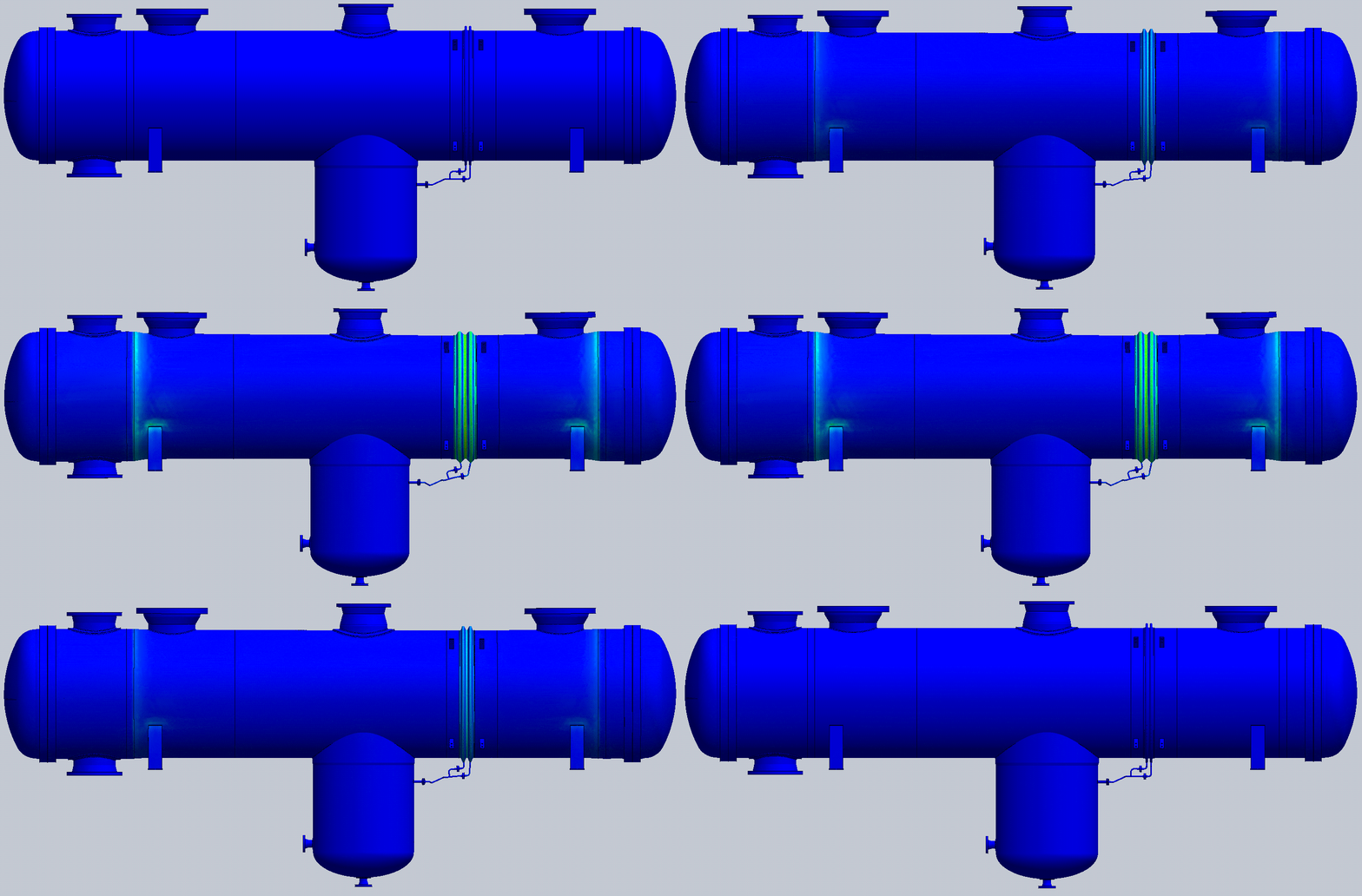
Introduction Expansion bellows are critical components in piping and heat exchanger systems, allowing for thermal expansion while minimizing stresses on connected equipment. Most bellows can be designed using hand calculations following EJMA standards, but complications arise when additional features, such as a drain piping penetration, are introduced into highly stressed areas. In this project, we … Read more

Optimizing Pressure Vessel Design for Material Savings

In engineering, material efficiency is a key factor in cost reduction, especially in pressure vessel and tank design. Over the years, I’ve been involved in several projects where optimization was essential to reduce material costs while ensuring compliance with design codes. One such project involved a horizontal pressure vessel, one of the largest in the … Read more