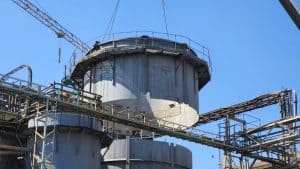

In our work on mixing systems and tank supports, we’ve repeatedly encountered the telltale signs of resonance-induced fatigue:
- Cracked pedestals
- Bent or fractured shafts
- Failed gearboxes
- Severely worn couplings
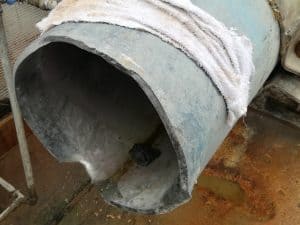
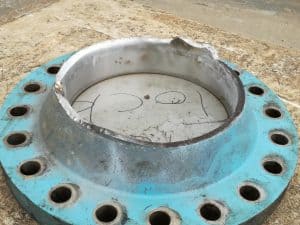
In one case, a 400 mm diameter shaft failed after just two months of operation. The failure was traced to fatigue, with similar damage found in adjacent pedestals, gearboxes, and couplings.
Finding the Root Cause
We were called in to perform a root cause analysis on the agitator system. Field vibration tests—including modal analysis and strain-gauge measurements—revealed peak amplitudes in the Fast Fourier Transform (FFT) spectrum at the agitator’s operating speed. These peaks coincided closely with one of the structure’s natural frequencies. Finite Element Analysis (FEA) confirmed the results, showing a strong correlation between measured and predicted modes.
Avoiding Failure: Stiffen Early, Don’t React Late
Rather than fixing fatigue failures in the field, it’s far more effective to design stiffness into the structure from the start. During the detailed design phase, use FEA to calculate the natural frequencies and ensure they are safely separated from any operating or excitation frequencies.
As a rule of thumb, aim to shift natural frequencies at least 20–25% above the dominant excitation frequencies or their harmonics.
Key Takeaways
- Perform modal analysis early—especially when mounting rotating equipment on steel structures.
- Ensure a minimum 20–25% separation between the structure’s natural frequencies and excitation forces.
- Resonance is not theoretical—it’s a common, preventable cause of fatigue failure.
By integrating dynamic analysis into your workflow, you can significantly improve the lifespan and reliability of your tanks, pedestals, shafts, and support structures.