



Understanding the Challenge
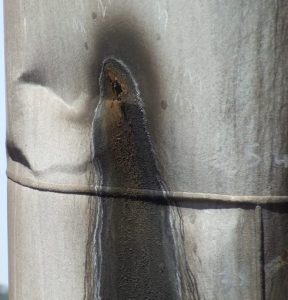
Wind loads on process columns, towers, stacks, and chimneys can be immense, particularly in environments like South Africa, where thunderstorms bring extreme gusts. Our challenge was assessing the structural integrity of a 75m high stack that already exhibited signs of local buckling due to corrosion. The primary concern was determining whether the stack could withstand future storms without catastrophic failure.
Finite Element Analysis (FEA) Approach
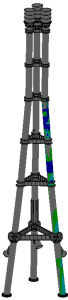
To evaluate the current condition of the stack, we employed Finite Element Analysis (FEA). The stack was modeled based on available drawings, repair records, and onsite measurements. A 3D shell model was created to simulate stress distribution and deformation under various load conditions.
Several load cases were considered, including:
- Self-weight – The corroded stack’s weight was almost 142 tons.
- Dead loads – Additional loads from platforms, staircases, and piping were included.
- Thermal expansion – The analysis accounted for temperature differences between different sections of the stack.
- Wind pressure – Based on a 3-second gust wind speed of 36 m/s, wind loading was applied to simulate worst-case compression stresses.
- Combined loading scenarios – Evaluating structural response under simultaneous dead weight, wind, and thermal loads.
Findings and Structural Integrity Assessment
The results revealed critical concerns:
- Widespread failure – A large portion of the stack failed to meet the design criteria outlined in ASME STS, necessitating replacement of large sections.
- Buckling due to wind and weight – The observed buckling patterns suggested failure mechanisms driven by a combination of self-weight and gust wind effects.
- Localized high-stress zones – Critical shell strakes, exhibited stress concentrations exceeding allowable limits, making them highly susceptible to collapse.
Recommended Repair Strategy
Given the stack’s condition, immediate intervention was required. The proposed repair methodology included:
- Reinforcement with shell strakes – Welding a full shell strake over the corroded sections, as successfully implemented in previous repairs.
- Structural enhancements at connection points – Instead of gussets, which could lead to stress peaks, the recommendation was to weld conical sections at support brackets to distribute stresses more efficiently.
- Inspection of previous repairs – Some earlier replaced sections did not fully comply with ASME STS buckling criteria, particularly the 8mm shell strake at Level 1, warranting further evaluation.
Ensuring Long-Term Stability
With further corrosion expected at a rate of 0.5mm to 1mm per 5 years, even currently stable sections could become critical in the near future. By implementing the recommended repairs and ongoing monitoring, the stack’s operational lifespan can be extended while mitigating risks associated with structural instability.
Through FEA, we gained invaluable insights into the stack’s vulnerabilities and developed a targeted approach to reinforce its structural integrity. The ability to simulate real-world loading conditions and predict failure mechanisms enables more effective decision-making for maintenance and repair, ensuring industrial safety in high-wind environments.