



As Mechanical Consulting Engineers, we often find ourselves reviewing Finite Element Analysis (FEA) reports, either for design verification or because a client is unsatisfied with a previous analysis. Unfortunately, many of these reports lack crucial information, making proper verification difficult. Here, we outline the non-negotiable sections of an effective FEA report, ensuring clarity and completeness for a reliable analysis.
1. SUMMARY
Start with a clear overview: what was analyzed, why the analysis was done, and the key results. Include the analysis objective (e.g., design validation, optimization, failure investigation, or safety verification), the scope of the model and the type of analysis performed (static, dynamic, buckling, fatigue, etc.).
This section should also highlight the most important findings, such as key stress results, critical deformation areas, and whether the design meets the intended criteria. The summary should be written in a way that even non-technical stakeholders can understand the purpose and conclusions of the report.
2. REFERENCES
List all standards, guidelines, technical papers, material data, and client-provided information used. This includes industry standards (such as ASME, ISO), textbooks, material databases (like ASME BPVC Sec. II, Part D), and any client specifications. Providing proper references ensures traceability and supports credibility, making it easier for others to verify the methods and data used. It also demonstrates that the analysis is compliant with relevant design codes and best practices.
3. ASSUMPTIONS
Detail any simplifications or conditions used during the analysis. These include material properties (such as assuming linear elasticity or isotropic behavior), and loading simplifications (e.g., distributed loads idealized as point loads).
Any assumptions made to simplify the model geometry should be cited. Assumptions about environmental factors (e.g., uniform temperature, wind and seismic conditions) should also be stated.
Clearly defining these assumptions helps establish the limitations of the analysis, ensuring that readers understand under what conditions the results are valid.
4. MODEL GEOMETRY
A. 3D CAD Model
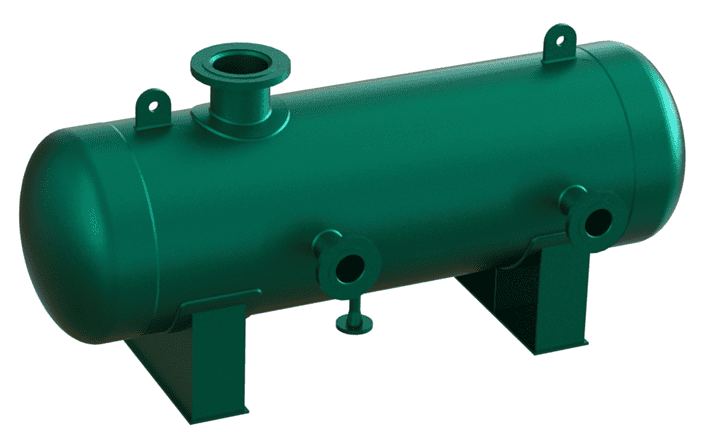
Describe the structure/components being analyzed, including key features, dimensions, and any simplifications made to facilitate analysis. Include details on geometric features like fillets, holes, and stiffeners, as well as any modifications made to the geometry, such as simplifications to remove minor features.
Providing visual diagrams or screenshots of the model is essential for clarity, as it helps others understand how the physical structure has been represented in the analysis and what approximations were made. Specify how the geometry was represented (Solid, Shell or Beam elements).
B. FEA Model
Include details about the mesh type (structured, unstructured, or hybrid) and the element types used, such as tetrahedral or hexahedral. Key information about element size and any local mesh refinement in critical areas, like stress concentrations, should be highlighted.
Mesh quality metrics, such as global mesh size and mesh refinement applied help assess the mesh’s integrity, while visualizations of the mesh provide a clear representation of its structure.
Additionally, any mesh sensitivity studies and assumptions or limitations related to meshing should be briefly discussed to ensure transparency and result validation.
Provide visual diagrams or screenshot of the the meshed model for clarity and to show where mesh refinement was applied.

C. Boundary Conditions
Explain the constraints, and interactions applied to the model. Boundary conditions such as fixed supports, symmetry planes, and contact conditions between different parts of the assembly should be clearly described. Specify and special elements used (Bolt connectors, Springs / Pins).
Include diagrams to illustrate these conditions, as they are crucial for ensuring the accuracy of the model and the relevance of the results to real-world conditions.

6. DESIGN CRITERIA
Define the performance standards and failure criteria that the model must meet. This includes allowable stresses, yield strength, safety factors, maximum allowable deflection, fatigue limits, and other operational requirements like thermal expansion limits.
Referencing design codes and standards (e.g., ASME Boiler and Pressure Vessel Code) is important here, as it provides a benchmark against which the results are evaluated.
Clearly defined design criteria help determine if the analyzed structure or component is fit for its intended purpose and helps communicate expectations to all stakeholders.
7. LOAD CASES
Outline all load conditions analyzed, including combinations of operational and extreme loads. Each load case should be described, specifying what loads are applied, how they are combined, and what environmental factors are considered (e.g., temperature, pressure).
Mention which load cases are most critical to the design and whether they represent typical operational scenarios or extreme events like seismic or accidental loads.
Including diagrams of each load case helps readers visualize the various scenarios and understand how the structure is expected to behave under different conditions.

8. RESULTS
Summarize key outcomes such as stress distribution, deformation, and critical failure areas. Present the most important findings for each load case, and indicate whether the results meet the defined design criteria. Use visual aids like contour plots to show stress distribution and displacement.
Highlight areas of concern, such as stress concentrations or excessive deformation. Present the calculated fatigue life if cyclic loading was analysed and indicate where fatigue failure might occur. If a buckling analysis was performed list the buckling load factor.
Show the temperature distribution across the model for all thermal load cases analsyed. Evaluate the results against the failure criteria indicated in point 6.
The results section should effectively communicate the impact of the loading conditions on the structure and provide a clear link between the analysis and the design criteria.
Ensure that stress contour plots are clearly labelled, and properly scaled with units. Show deformed shapes of the model for each case with exaggeration if necessary for better visualization.
 9. CONCLUSIONS
 9. CONCLUSIONS
Provide a concise summary of whether the design meets the required standards. Highlight key findings, such as areas of high stress or deformation that may need attention. Include recommendations for next steps, such as design changes to address critical issues, further testing to validate assumptions, or moving forward with fabrication.
This section should give stakeholders a clear understanding of the overall success of the analysis and what actions are necessary to proceed with confidence.
10. APPENDICES
Include supplementary information like information supplied by the client, additional hand calculations. Appendices can also include material property data, additional plots, or mesh convergence studies to demonstrate the validity of the model. This detailed information supports transparency and traceability, providing deeper insights into the modeling process for readers who need it while keeping the main body of the report concise and accessible.
FINAL THOUGHTS
An effective FEA report should be thorough yet concise, covering essential elements without unnecessary complexity. Avoid including excessive raw data, software screenshots, or overly technical jargon that doesn’t add value to the reader’s understanding.
The goal is to communicate the analysis clearly and effectively to all stakeholders, from engineers to decision-makers.
Need Help with Your FEA Reports?
If you’re looking to ensure your FEA analysis is comprehensive and reliable, we’re here to help. Reach out to our team for guidance or verification services.